Asterfold app iconAsterfold · for sunset hikers

Sunset isn't
when it gets dark.

When to leave the top, from your city, date and descent time. An estimate, worked out in your browser.

YouI'm watching sunset from the top. When do I start down?

Descent time
Download Asterfold: Sunset Planner on the App StoreFree on iPhone
Works offline for sun times

How long before sunset should you start down a hike?

Plan to finish your descent by the end of civil twilight, about 25 to 40 minutes after sunset in open terrain at mid-latitudes, so leave the top at least your descent time plus a buffer before that. In forest or a deep valley, it gets dark sooner, so treat civil twilight as a ceiling, not a target.

The calculator above uses the formula leave the top = end of civil twilight − descent time − 15 minutes. It's deliberately simple so you can check it in your head. The sun maths is the NOAA solar position algorithm, run in your browser; nothing is sent anywhere.

Six sunset hike mistakes, and the fix for each

Tap each message to see the reply.

  1. HikerI'll head down at sunset.

  2. HikerThe forecast says sunset at 4:38, so I'll be at the top by 4:35.

  3. HikerGoing down is quicker, so I'll budget half the time.

  4. HikerMy phone is my light.

  5. HikerIt's warm at the car, I'll skip the jacket.

  6. HikerWe'll decide when to turn around once we're up there.

The fix is nearly always the same: decide the time at the car, not at the view.

Mini story: the ridge that ate twenty minutes

An invented example.

HikerSunset 4:41. Trail is 50 minutes up, 40 down. Leaving the car at 3:40, easy.

AsterfoldTonight the Sun sets at about 238°. Sun positions assume a flat horizon, so if a ridge sits on that bearing it will vanish early. Be up there with time to spare.

HikerSun went behind the ridge at 4:20. Glad we were up early. Watched the colour, headed down at 4:35 as planned, at the car by 5:15 with headlamps still in the pack.

AsterfoldRate what you saw in two taps? It goes in your field journal next to the forecast we saved before sunset.

How Asterfold helps you plan a sunset hike, in three steps

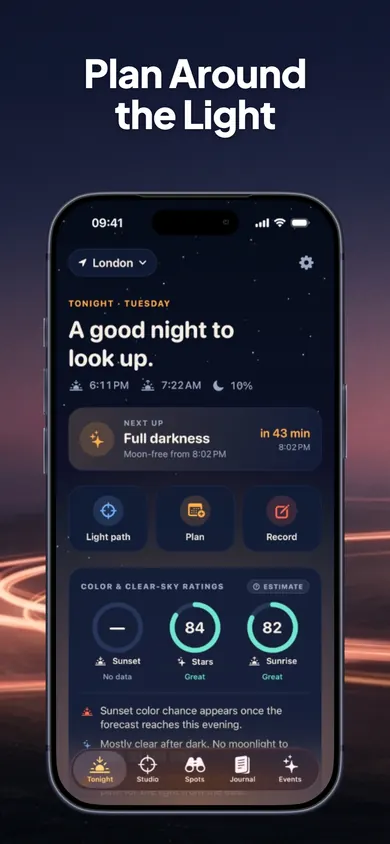
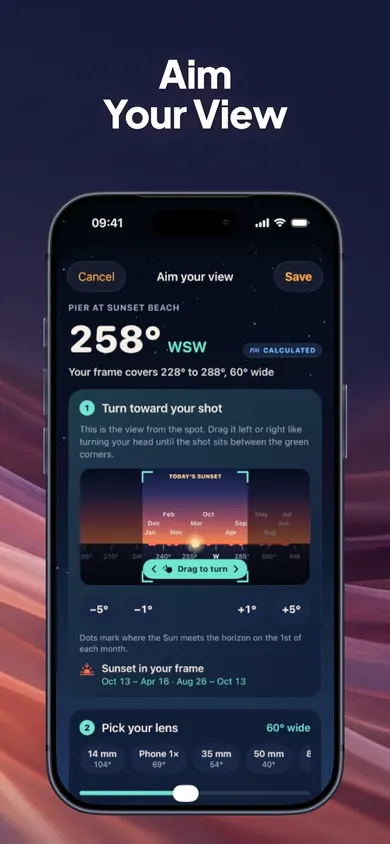
  1. Save the viewpoint. Pin the exact spot you'll watch from, then aim your view on a first-person horizon to see where the Sun meets it tonight.
  2. Plan the session. Pick the light window (golden hour, sunset or blue hour), add a reminder and a short checklist, and put "headlamp" on it.
  3. Go, then record. Open the spot in Maps when it's time to leave. Afterwards, rate the sky in two taps for your field journal.
Asterfold Plan a session screen with viewpoint, date, golden hour light window, golden hour 5:26 to 6:32 PM and sun bearing 249 degrees
A planned session: light window, times and bearing.
Asterfold Aim your view screen showing a frame from 228 to 288 degrees and the dates the Sun sets inside it
Aim your view to see when the Sun sets inside your frame.

Sunset vs civil dusk vs nautical dusk

Sunset

Sun's top edge at the horizon

Still bright. Colour often peaks after this. Start thinking about leaving.

Civil dusk

Sun 6° below

Per the NWS, horizon and ground objects are still visible in clear weather. Your last usable light in open terrain.

Nautical dusk

Sun 12° below

Outlines only. The NWS notes detailed outdoor activity generally needs artificial light. Headlamp time.

Who Asterfold is not for

  • It isn't a trail or navigation app. There are no trail maps, no route tracking and no safety alerts; carry a real map and tell someone your plan.
  • Sun positions assume a flat horizon. Hills, buildings and trees aren't modelled, so if you need full terrain shading, a 3D photo planner is a better fit.
  • Ratings for tonight's sky are a rule-of-thumb estimate, not a probability. Free covers the Studio, aiming and plans for 2 viewpoints, tonight's ratings and the next 3 evenings; unlimited viewpoints, smart sky alerts and the 10-day outlook are Asterfold Plus.

A design decision we made: forecast, calculated, estimated and observed data are labelled differently in the app, so you always know which numbers are maths and which are guesses.

Sunset hike questions

How long after sunset does it get dark on a trail?

In open country, civil twilight usually gives you roughly 25 to 40 minutes of usable light after sunset at mid-latitudes, longer further north and in summer. Under trees or in a valley it gets dark sooner. The calculator above shows tonight's civil twilight end for your city as an estimate.

What is civil twilight?

The National Weather Service defines the end of evening civil twilight as the moment the Sun's centre is 6 degrees below the horizon. Until then, in clear weather, you can usually make out the horizon and objects on the ground without artificial light.

When should I turn around on a sunset hike?

Before you start, pick a time to leave the viewpoint so that your descent ends by the end of civil twilight with a buffer to spare, and stick to it. The Washington Trails Association recommends setting a realistic turnaround time before you start and keeping it.

Do I need a headlamp for a sunset hike?

Yes. The National Park Service's Ten Essentials list includes illumination and recommends a headlamp because it is hands-free, plus spare batteries. A phone torch drains the battery you may need for navigation or a call.

Why does the sun disappear before the official sunset time?

Official sunset assumes a flat, sea-level horizon. A ridge, a tree line or buildings to the west hide the Sun earlier. Asterfold's Sun positions make the same flat-horizon assumption, which is why we tell you to check your real skyline.

Is this calculator accurate?

It uses the NOAA solar position equations in your browser, which are typically within a minute or two for sunset in open terrain. Treat the result as an estimate: terrain, trees, weather and your own pace matter more than the last minute of the maths.

Catch the light, then catch the trail

Plan the viewpoint, the light window and the checklist before you leave the car.

Download Asterfold: Sunset Planner on the App Store

Get Asterfold free on the App Store

Updated November 2026

Related