Blue hour · myths vs facts

Catch every
blue hour.

For photographers and evening walkers: drag from sunset to dark and see how long blue hour lasts where you are.

Blue hour

Sunset

Estimating…

Download Asterfold: Sunset Planner on the App StoreFree on iPhone · works offline for Sun times

How long does blue hour last?

Blue hour usually lasts about 15 to 40 minutes, not an hour: roughly 16 minutes near the equator, about 20 minutes at 40 degrees latitude in spring, and about 30 minutes as far north as Oslo. Those figures come from timeanddate.com's blue hour guide, which places blue hour when the Sun is about 4 to 8 degrees below the horizon.

The slider above runs the NOAA solar calculator algorithm in your browser for the city and date you choose. It is an estimate: it assumes a flat horizon and knows nothing about cloud.

Blue hour is a band of Sun angles, so its length is set by how steeply the Sun sinks where you stand.

How Asterfold plans blue hour, in 3 steps

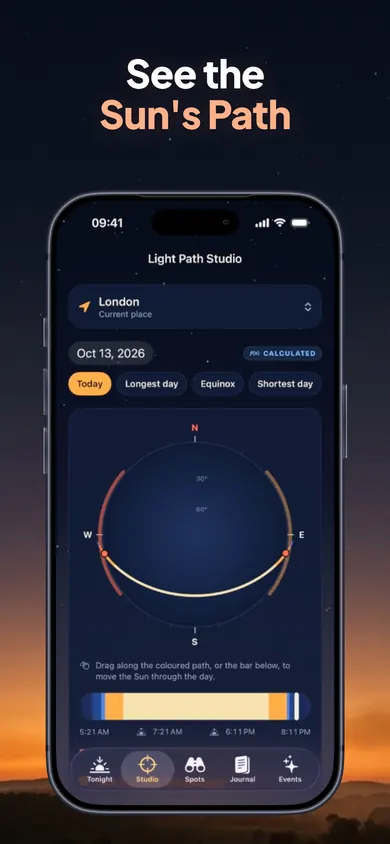
  1. See the Sun's path. The Light Path Studio draws the Sun's real path for any place and date on a sky dome, coloured by golden hour, blue hour and twilight. It is calculated on your iPhone, so it works offline.
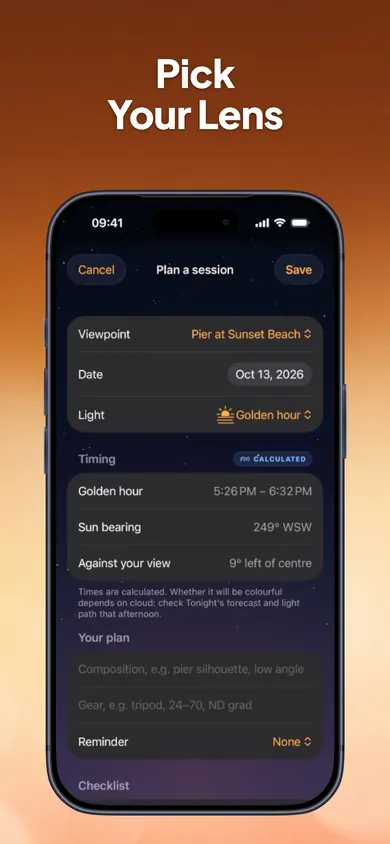
  2. Plan the session. Choose blue hour as the light window, then add composition notes, gear, a reminder and a short checklist.
  3. Record what happened. After sunset, rate what you saw in two taps in the field journal, with colours, clouds and a note.

Annotated tour: the screens behind the steps

Asterfold Light Path Studio with a sky dome showing the Sun's path and a timeline bar from day to twilight
  1. Date shortcuts. Today, longest day, equinox and shortest day sit above the dome, so you can compare seasons in two taps.
  2. The coloured path. The Sun's arc is coloured by phase. Drag along it to scrub through the day for altitude, bearing and shadow length.
  3. The bar at the bottom. The day as a strip from sunrise to dark; the deep blue band near the end is where blue hour falls.
Asterfold Plan a session screen with viewpoint, date, light choice and calculated golden hour timing
  1. Light. Pick golden hour, sunset or blue hour for the session.
  2. Timing, labelled Calculated. Times are maths, not a forecast, and the app says so.
  3. Your plan. Composition, gear, a reminder and a checklist, then open the spot in Maps.

A mini story: the bridge at 5:02

It was December 10 in Chicago. He had read "blue hour" and planned to arrive an hour after sunset. Sunset was at about 4:20. He got to the river at 5:20, and the sky was already close to black.

Next week he checked first. The estimate put the start of blue hour, with the Sun 4 degrees down, at about 4:38, and the end of the deeper band, 8 degrees down, at about 5:02. He set up at 4:30, shot the bridge lights against the blue at 4:50 and was packing up at five.

An illustrative scenario we wrote, not a user story. Times are rounded estimates.

Blue hour myths vs facts

MythBlue hour lasts an hour.

FactIt is usually 15 to 40 minutes. timeanddate.com gives about 16 minutes in Quito, about 20 at 40 degrees latitude in March and about 30 in Oslo.

MythBlue hour starts the moment the Sun sets.

FactFirst comes the afterglow. Blue dominates once the Sun is roughly 4 degrees below the horizon, often 15 to 25 minutes after sunset at mid-latitudes.

MythIt is the same length everywhere, all year.

FactIt depends on latitude and season. Near the equator it is short year-round; near the poles in winter it can last several hours.

MythBlue hour is just another name for civil twilight.

FactCivil twilight ends when the Sun is 6 degrees down. Blue hour sits around 4 to 8 degrees down, overlapping civil and nautical twilight.

MythThere is an official definition.

FactThere isn't. timeanddate.com calls it a colloquial term. Apps and guides use slightly different cut-offs, which is why times disagree by a few minutes.

MythIt only happens in the evening.

FactThere is a morning blue hour too, before sunrise, running in reverse from deep blue to lighter blue.

Facts from timeanddate.com's blue hour guide and timeanddate.com's twilight guide.

Blue hour length by season, for your city

The same calculation for four key dates this year. "Narrow" is the Sun from 4 to 6 degrees below the horizon; "wide" is 4 to 8 degrees.

DateStartsNarrowWide

Estimate using the NOAA solar algorithm, flat horizon, no weather. City: .

Honest limits

Who should pick something else: if you need precise twilight tables for navigation or research, use the official NOAA calculator directly. One design decision we made: Asterfold labels calculated, forecast, estimated and observed data differently, so a Sun time never looks like a weather promise.

Blue hour questions

How long does blue hour last?

Usually somewhere between about 15 and 40 minutes, not a full hour. timeanddate.com gives about 16 minutes in Quito near the equator, around 20 minutes at 40 degrees latitude in March, and roughly 30 minutes in Oslo at the same time of year. Near the poles in winter it can last for hours.

When does blue hour start after sunset?

Not right away. Blue tones dominate once the Sun is roughly 4 degrees below the horizon, which is often 15 to 25 minutes after sunset at mid-latitudes. The slider on this page estimates the exact clock time for your city and date.

Is blue hour the same as civil twilight?

No. Civil twilight runs from sunset until the Sun's centre is 6 degrees below the horizon. Blue hour is usually placed at about 4 to 8 degrees below, so it overlaps the end of civil twilight and the start of nautical twilight.

Is there a blue hour in the morning?

Yes. The same Sun angles happen before sunrise, in reverse: deep blue first, then lighter blue, then the warm light of golden hour.

Why is blue hour longer in winter in the north?

At high latitudes the Sun sinks at a shallow angle in winter and summer, so it takes longer to pass through the same few degrees below the horizon. Close to the equator it drops almost straight down, so blue hour is short all year.

Does Asterfold show blue hour?

Yes. The Light Path Studio colours the Sun's path by golden hour, blue hour and twilight for any place and date, calculated on your iPhone, and Plan a Session lets you pick blue hour as your light window.

Is Asterfold free?

Free includes the Studio, aiming and plans for 2 viewpoints, the journal, check-ins and tuning, tonight's ratings, the next 3 evenings and 45 days of events. Asterfold Plus adds unlimited viewpoints, smart sky alerts, the full 10-day outlook and a year of sky events.

Get Asterfold free.

See tonight's blue hour on the Sun's real path, then plan the shot.

Download Asterfold: Sunset Planner on the App Store

Get Asterfold free on the App Store · Updated November 2026

Related