Updated November 2026
What time should you schedule golden hour photos?
Schedule an evening session to start when the Sun is about 6 degrees above the horizon, usually 30 to 60 minutes before sunset, and plan to keep shooting until roughly 20 to 40 minutes after sunset for blue hour. The exact clock time depends on your latitude and the date, which is why a fixed "one hour before sunset" rule is often wrong.
That 6-degree mark comes from timeanddate.com's golden hour guide, which notes golden hour has no official definition and puts the warm light roughly between 6 degrees above and 6 degrees below the horizon. It also explains why the length changes: near the equator the Sun drops almost straight down, so it passes through that band fast; further from the equator it slides down at a shallow angle and lingers.
In short: book by Sun angle, not by the clock, and add 15 minutes to arrive.
What the app shows when you plan a shoot
We make Asterfold, a sunset planner for iPhone. These are its own store screenshots. Plan a Session lets you pick the light window, see the golden hour times and the Sun's bearing against your saved view, then add notes, gear, a reminder and a checklist.
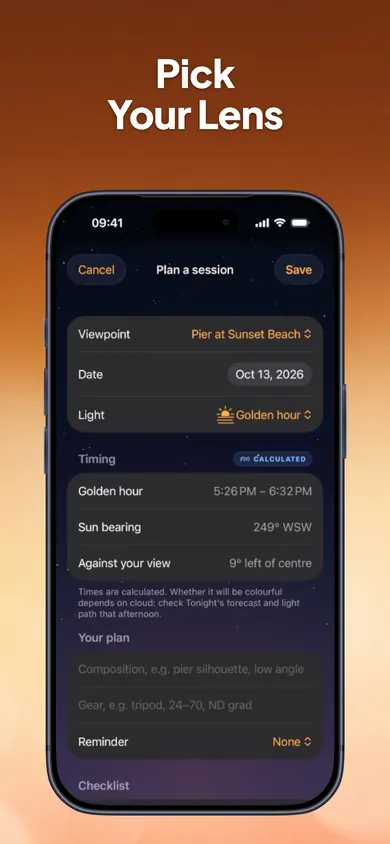
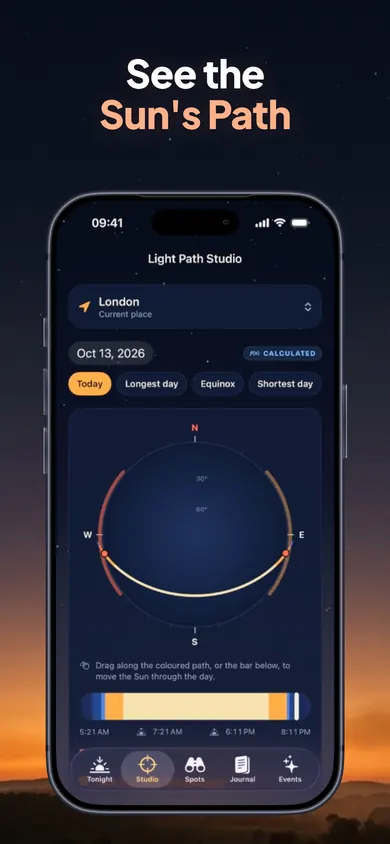
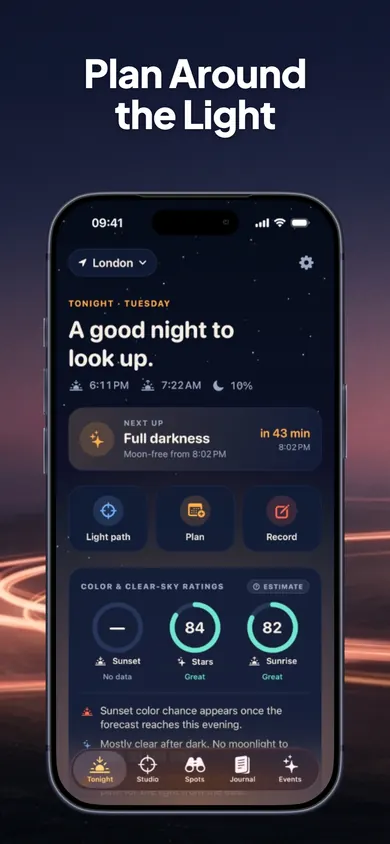
Golden hour length by city and season
We ran the same NOAA-based calculation the tool above uses for a handful of cities in 2026. "Before sunset" is the time from the Sun at 6 degrees to sunset; "after" is sunset to the Sun at 6 degrees below, the end of civil twilight.
Minutes before sunset / after sunset. Calculated, flat horizon, not observed.
The further from the equator, the longer the light lasts, and midwinter is longer than spring.
A worked example: a November engagement shoot
Say a couple books a park in New York for Saturday 14 November 2026. Choose New York and that date above and the calculator gives the Sun at 6 degrees around 3:58 PM, sunset around 4:38 PM, and the end of civil twilight around 5:08 PM.
- 3:43 PM Arrive, walk to the first spot.
- 3:58 PM First frames: warm side light, long shadows.
- 4:38 PM Sunset: backlit shots, the sky starts doing the work.
- 4:56 PM Sun about 4 degrees below: blue hour begins, add the city lights.
- 5:08 PM Wrap. It is getting dark fast.
A booking at "5 PM because sunset is around then" would have missed almost all of it. In mid-May in Los Angeles the same plan shifts to a first frame around 7:12 PM and a sunset around 7:47 PM.
Honest limits of this calculator
- It is an estimate. It uses the NOAA solar calculator equations, which NOAA describes as accurate to within about a minute between 72 degrees north and south for sunrise and sunset. Real light depends on the air and the cloud.
- It assumes a flat horizon. A ridge, tree line or tall buildings to the west can put your subject in shade 20 or 30 minutes early. Asterfold has the same limit and says so: hills, buildings and trees are not modelled.
- It knows nothing about weather. Asterfold's Tonight screen adds hour-by-hour cloud from MET Norway with forecasts toward the setting Sun, and labels its ratings as a rule-of-thumb estimate, not a guarantee.
- City centres only. Times shift by about a minute for every 15 to 20 km east or west. For a precise spot, use the app with a saved viewpoint.
Who should use something else
If you only need tonight's sunset time once, your phone's weather app is enough. If you plan landscape shots across many locations with topography, a dedicated 3D planner that models terrain will serve you better. Asterfold is built for people who shoot from a few favourite places and want to learn how their own sky behaves: it keeps a field journal and compares each check-in with the forecast it saved before the sunset.
A design decision we made: Asterfold labels calculated, forecast, estimated and observed data differently, everywhere. A sunset time is maths; a colour rating is a guess. Mixing them up is how people end up blaming the weather for a bad plan.
Free vs Plus: Free includes the Studio, aiming and plans for 2 viewpoints, the journal, tonight's ratings, the next 3 evenings and 45 days of events. Plus adds unlimited viewpoints, smart sky alerts, the full 10-day outlook and a year of sky events.
Golden hour scheduling questions
What time should a golden hour photoshoot start?
For an evening session, start when the Sun is about 6 degrees above the horizon, which is usually 30 to 60 minutes before sunset depending on where you are and the time of year. Arrive 15 minutes earlier to park, walk in and settle. The calculator above gives an estimate for your city and date.
How long before sunset is golden hour?
It varies. Near the equator the Sun drops fast, so the warm, low light before sunset can be barely half an hour. Around 40 degrees latitude it is often 35 to 45 minutes; around London it can be close to an hour in December. Our table below shows worked examples.
Should we book a morning or an evening golden hour session?
Evening is easier for most people: nobody has to be ready before dawn, and the light keeps getting warmer as you shoot. Morning sessions trade an early alarm for empty locations and calm air. The light quality is similar.
What happens if it's cloudy?
A thick bank of low cloud on the western horizon can cut the light off early, even if overhead looks clear. A thin, high cloud layer can make the sky more colourful. Check a cloud forecast the day before and keep a backup date.
Is golden hour really an hour?
Rarely. The name is loose. Golden hour has no official definition; timeanddate.com describes it as roughly when the Sun is between 6 degrees below and 6 degrees above the horizon, and its length depends on latitude and season.
Does Asterfold work for client sessions?
Asterfold plans around saved viewpoints: you choose the light window (golden hour, sunset or blue hour), add composition notes, gear, a reminder and a checklist, and open the spot in Maps. Free covers 2 viewpoints; Asterfold Plus adds unlimited viewpoints.
Make it a habit with Asterfold
Save your spots, plan the light, then record what the sky really did.

Related
- Asterfold: golden hour and sunset plannerSee where the Sun sets from your own viewpoint, when golden and blue hour start, and how the sky really turned out. Free on iPhone.
- A 14-evening sunset photography challenge with dated timesA 14-evening sunset photography challenge: one prompt a night, a progress ring, and estimated sunset times and directions for your city.
- Earliest sunset of the year: find your city's dateThe earliest sunset comes before the winter solstice. Pick your city to see the 2026 date and time, the latest sunrise, and when evenings get longer.
- How to find where the sun will set from a window or balconyTap the way a window, balcony or viewpoint faces and see which months it catches the sunset in your city. Estimated with the NOAA solar method.