How do you find where the sun will set?
Look up the sunset's compass bearing for your place and date, then check that bearing against the way your window, balcony or viewpoint actually faces, and against anything tall in between. The checker above does the first two for you by month. A flat-horizon estimate cannot see the hotel next door, so the last step is still yours: look at a map, or ask the host for a photo taken from the balcony at sunset.
"West-facing" is a promise about direction, not about the view.
Who this page is not for
This page is for people choosing where to be: travellers picking a hotel room or rental with a sunset view, home hunters comparing a west and a south balcony, anyone planning a proposal or a picnic at a lookout. It is not for:
- Landscape photographers lining up a shot to the degree. You want a full planner. Asterfold's Aim Your View does this, and so do desktop-first tools like The Photographer's Ephemeris and Sun Surveyor.
- People in the far north or south in mid-summer or mid-winter. The Sun may not set normally at all; the checker will tell you when that happens.
- Anyone who needs to know if the sky will be pretty. Direction is geometry; colour depends on cloud. That is a forecast question.
How to check a view in 3 steps
- Find which way it faces. On a listing, look for the floor plan's north arrow or drop a pin on a map and see which way the windows point. In person, use your phone's compass with true north turned on, held flat, away from metal railings.
- Match it to the sunset bearing for your dates. Tap that direction in the checker. A 90-degree view (45 degrees either side) is a fair stand-in for a window or balcony. Check the months you will actually be there, not the summer brochure.
- Look for blockers. Hills, towers and trees in the sunset direction cut it short. A street-view look along that bearing takes two minutes and saves a disappointing week.
Sunset direction by season, in plain words
| Time of year | Northern hemisphere | Southern hemisphere |
|---|---|---|
| Late June | Furthest north of west | Furthest north of west (shortest days) |
| Late March, late September | Close to due west | Close to due west |
| Late December | Furthest south of west | Furthest south of west (longest days) |
The swing grows with latitude. Tap a city near the equator and then one far from it in the checker to see the shaded range widen.
A mini story: the two balconies
A couple were choosing between two flats for a December trip to Lisbon: one with a west balcony, one with a south-west balcony a little cheaper. The listing photos both showed glowing sunsets, taken who knows when. In the checker, the west balcony technically caught the sunset all year, but in mid-December the Sun set at about 240 degrees, close to the left edge of its view, where a neighbour's wall would hide it. The south-west one had December squarely in frame. They booked the cheaper flat, and then checked a street view along that bearing for tall buildings. There were none.
An illustrative scenario we wrote, not a user story. Bearings are estimates from this page's checker.
What Asterfold adds for your exact spot
The checker uses city centres. Asterfold works from the exact place you will stand: save the viewpoint, turn toward your shot on a first-person horizon, and it lists the dates this year when the Sun sets inside your frame, plus the next seven sunsets against it. It is calculated on your iPhone, so it works offline.
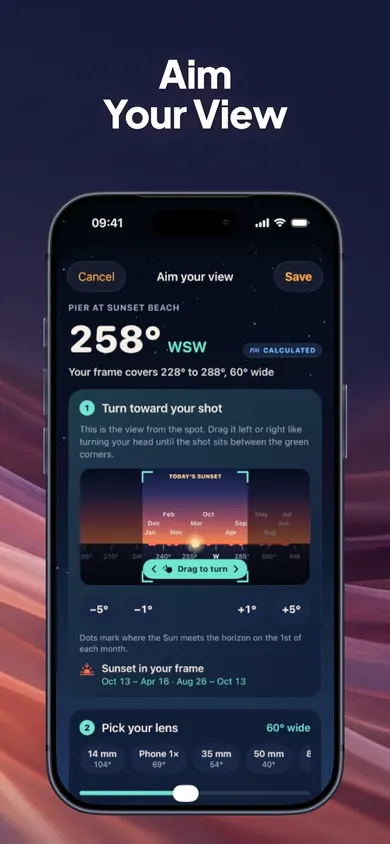
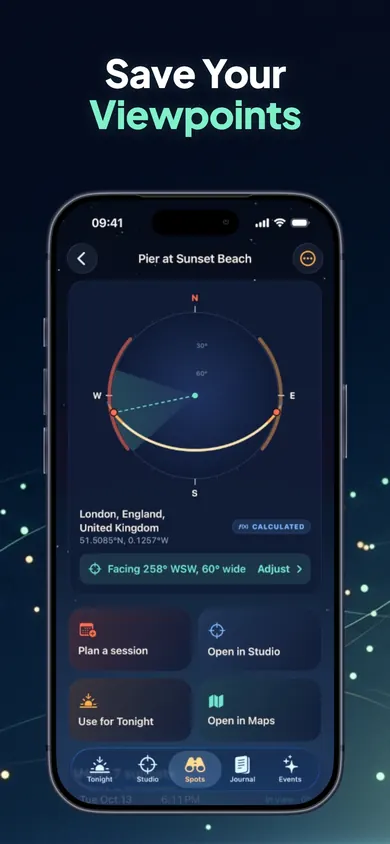
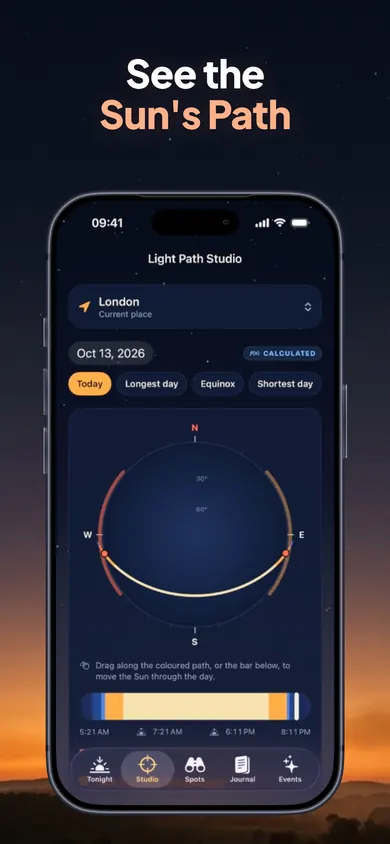
One decision we made: Asterfold labels calculated, forecast, estimated and observed data differently, and it says plainly that sun positions assume a flat horizon. Free covers 2 viewpoints and 45 days of events; unlimited viewpoints and a year of sky events need Asterfold Plus.
Sunset direction questions
How do you find out which direction the sun sets?
Look up the sunset azimuth (compass bearing) for your place and date, then stand at your spot and face that bearing with a compass. The checker on this page estimates it for 24 cities; Asterfold does it for your exact spot and lets you aim a first-person horizon.
Does the sun always set in the west?
Only roughly. Near the March and September equinoxes it sets close to due west everywhere. In northern summer it sets well north of west, and in northern winter well south of west. The further from the equator, the bigger the swing.
Will a west-facing balcony see the sunset all year?
In most mid-latitude cities, a west-facing view with about a 90-degree field catches the sunset most of the year, but the Sun can slide out of frame near the solstices. Tap W in the checker for your city's months.
Is a phone compass accurate enough?
For deciding which side of a building faces the sunset, usually yes. Turn on true north in your iPhone's Compass settings, hold the phone flat, and keep it away from metal railings and car bodies.
Why does the sunset happen earlier than the app says at my spot?
Sunset times, here and in Asterfold, assume a flat horizon. Hills, buildings and trees hide the Sun before it reaches the true horizon, so a view with a tall building to the west loses the Sun earlier.
Is Asterfold free?
Free includes the Light Path Studio, aiming and plans for 2 viewpoints, the field journal, tonight's ratings, the next 3 evenings and 45 days of events. Asterfold Plus (yearly with a 7-day free trial for eligible new subscribers, monthly, or lifetime) adds unlimited viewpoints, smart sky alerts, the 10-day outlook and a year of sky events.
Know the side before you book
Save the spot, aim the view, see the dates.

Get Asterfold free on the App Store
Updated November 2026
Related
- Asterfold: golden hour and sunset plannerSee where the Sun sets from your own viewpoint, when golden and blue hour start, and how the sky really turned out. Free on iPhone.
- Earliest sunset of the year: find your city's dateThe earliest sunset comes before the winter solstice. Pick your city to see the 2026 date and time, the latest sunrise, and when evenings get longer.
- What time to book a golden hour photo sessionPick a city and date to get an estimated start time for golden hour photos: when to arrive, first frame, sunset and blue-hour wrap.
- How long does blue hour last? Myths vs factsBlue hour lasts about 15 to 40 minutes in most places, not an hour. Six myths vs facts, plus a slider that estimates it for your city and date.